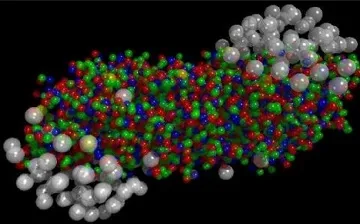
The nuclear theory group carries out research into the structure and behavior of strongly interacting matter in terms of its basic constituents -- quarks and gluons -- over a wide range of conditions: from nucleons and nuclear matter to the cores of stars, and from the Big Bang that was the birth of the universe to the heavy-ion collisions in present-day experiments. We use our expertise to explore new paths to achieve civilian use of nuclear fusion and to understand the evolution of particles and plasmas in primordial Universe.
Our main strength is the creation of novel ideas and tools for unraveling the non-perturbative properties of strongly interacting particles, and we apply them to interdisciplinary problems at the interface with particle, atomic, laser, condensed-matter, and astrophysics and employ artificial intelligence in exploration of frontier challenges in the field. Examples of our interdisciplinary interests include the production of top quarks at LHC, nuclear fusion and fission, strong fields, trapped atoms near Feschbach resonances, and supernovae neutrinos.
Our group is internationally recognized for leading the study of nuclear physics from the perspective of quantum chromodynamics (QCD). We have invented Soft Collinear Effective Theory to describe high-energy quarks and gluons, and Nuclear Effective Field Theories to deduce the force among nucleons. We have formulated the innovative No-Core Shell Model to predict the properties of nuclei from fundamental nucleon interactions, and have investigated equilibrium and non-equilibrium properties of nuclear matter. We have also done pioneering work on applications of perturbative QCD to nuclear collisions at the highest attainable energies, and discovered that heavy quarks provide a revolutionary tool for the investigation of a new state of matter recreated in these collisions: the quark-gluon plasma that existed 20 microseconds after the Big-Bang.
The group publishes extensively in professional journals -- three of our papers have been chosen as "50th Anniversary Milestones" by Physical Review C & D because they "announce major discoveries or open up new avenues of research -- and members of our group have received numerous awards, including two Sloan Fellowships, two DOE Outstanding Junior Investigator Awards, a Humboldt Senior Scientist Award and a DFG-Excellence Professorship, the UA Koffler Prize, the APS Feshbach Prize, APS Fellowships, and membership in the Academia Europaea.